How to Build a Sales Funnel for a Kenyan Service Business (2026 Step-by-Step)
What a Sales Funnel Actually Is for a Kenyan Service Business
A sales funnel is the documented, repeatable system through which a stranger becomes a paying customer. For a Kenyan service business, it is the answer to the question: “what is our process for turning interested visitors into paying clients, and how predictable is each stage?”
The businesses that grow predictably in Kenyan service markets have documented funnels with measurable conversion rates at each stage. The businesses that grow erratically — bursts of clients followed by quiet months — typically have no funnel, just hopeful inbound enquiries.
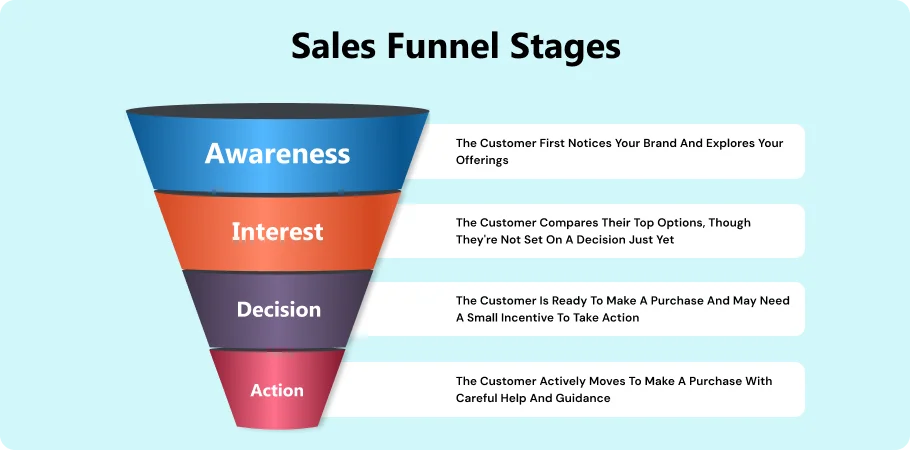
The Five Stages of a Kenyan Service Business Funnel
Stage 1: Awareness — strangers discover you exist
The audience does not yet know your business. They are searching for solutions to their problem (Google searches), browsing relevant content (blogs, social media), or being influenced by people who do know you (referrals, peer recommendations). The goal: deliver enough value or relevance to earn permission to continue the conversation.
Kenyan service business awareness channels: SEO content targeting commercial-intent keywords, Google Ads on the same keywords, LinkedIn content from executives, paid social advertising, podcast appearances, partnerships with complementary services, and direct outreach.
Stage 2: Interest — they engage with your content
The prospect has discovered you and finds something valuable enough to engage further. They read multiple blog posts, follow you on social, watch your videos, or download a piece of content. They are not yet ready to buy, but they have signalled enough interest to be worth nurturing.
The goal of this stage: build trust progressively while collecting permission to continue communicating (email subscription, WhatsApp opt-in, phone number for personalised follow-up).
Stage 3: Consideration — they evaluate you against alternatives
The prospect has identified your category as a potential solution and is comparing options. For a Kenyan service business, this means competitor websites, peer recommendations, and direct conversations to evaluate fit. The goal: make their evaluation as easy and confidence-building as possible. Specific case studies addressing their context. Pricing transparency or clear pricing conversation. Proof of capability through testimonials with verifiable outcomes.
Stage 4: Intent — they engage in direct conversation
The prospect has decided your category is the right solution and your business is on their shortlist. They request a consultation, fill out a contact form, or message via WhatsApp. The goal: deliver an exceptional first conversation that establishes specific fit and moves them confidently toward decision.
Stage 5: Decision — they become a paying customer
The prospect commits — signs the contract, pays the deposit, schedules the work to begin. The goal: make the commitment easy, low-risk, and aligned with how they prefer to engage. Multiple payment options including M-Pesa STK push, clear contract terms in plain language, defined deliverables and timeline.
Building Each Stage of a Kenyan Service Business Funnel
Awareness stage construction
The minimum viable awareness layer for a Kenyan service business: 12–20 SEO-optimised blog posts targeting your most commercially valuable keywords, an active Google Business Profile generating local search visibility, weekly LinkedIn content from the founder/CEO, and a defined paid traffic source (Google Ads or Meta) feeding additional cold audiences. Without an awareness layer, the rest of the funnel has no input — leads cannot enter a funnel that has no top.
Interest stage construction
The conversion mechanism turning awareness into interest: a lead magnet that solves a specific problem for your target audience. Examples for Kenyan service businesses: “The Kenyan Web Performance Audit Checklist,” “How to Calculate Your CAC for a Kenyan SME,” “The 2026 Kenyan Business SEO Checklist.” Build a dedicated landing page for each lead magnet with a clear value proposition, name and email opt-in form (only two fields), and immediate delivery of the asset by email after submission.
Consideration stage construction
Email nurture sequence delivering value over 3–4 weeks: educational content addressing specific challenges, case studies showing relevant client outcomes, transparent answers to common questions, and progressive trust-building before any direct sales push. The sequence does the qualification and education work that manual sales conversations would otherwise require — making the eventual sales conversation higher-quality and more efficient.
Intent stage construction
The conversion mechanism for converting nurtured leads into sales conversations: a clear, friction-light call-to-action present throughout your nurture content. For Kenyan service businesses, the highest-converting CTA is typically: “Book a free consultation/audit” with a calendar booking link (Calendly, Google Calendar, SavvyCal) or “WhatsApp us to discuss your project” with a pre-filled WhatsApp link.
Decision stage construction
The sales process from first conversation to signed contract: structured discovery conversation (30–45 minutes) understanding their specific situation, needs, and decision criteria; written proposal addressing their specific context (not a generic template); follow-up sequence if no immediate decision (3 emails over 2 weeks); contract and payment process designed for ease (electronic signature via DocuSign or HelloSign, payment via M-Pesa or bank transfer, simple terms in plain language).
The Tooling Stack for a Kenyan Service Business Funnel
Minimum viable stack: WordPress website with proper SEO setup; email automation platform (Mailchimp, ActiveCampaign, or Brevo); calendar booking tool (Calendly free tier); WhatsApp Business; CRM (HubSpot free tier sufficient for SMEs starting out); and Google Analytics 4 with proper conversion tracking. Total monthly subscription cost: KES 5,000 – 25,000 depending on tier choices. The tooling is not the differentiation — the strategic clarity and execution discipline are.
Measuring and Optimising the Funnel
Track conversion rate at each stage monthly: visitor to lead, lead to qualified opportunity, opportunity to closed customer. Identify the weakest stage and prioritise optimisation there — improving a 1% stage to 3% has more impact than improving a 30% stage to 35%. Common Kenyan service business optimisation findings: lead-to-qualified opportunity is typically the weakest stage (poor email nurture or CRM follow-up); landing page conversion rate is often improvable through better message match and form simplification; sales close rate improves with better discovery conversation structure.
Common Kenyan Service Business Funnel Failures
Funnel without traffic. A sophisticated funnel with no traffic source produces zero results. Often businesses spend heavily on funnel infrastructure before validating they have a sustainable traffic source — and the funnel sits empty.
Traffic without funnel. The opposite failure — driving expensive traffic to a website with no conversion mechanism, no lead capture, and no follow-up. The traffic spend produces nothing because there is no funnel to capture it.
Funnel without sales follow-up. Leads arriving in the CRM but receiving no consistent follow-up. Most Kenyan service businesses lose 40–60% of qualified leads to follow-up failure — not lack of leads.
Funnel measured by activity, not outcomes. Tracking emails sent, posts published, and ads run rather than leads generated, opportunities created, and customers acquired. Activity does not equal outcomes — measure what matters.
Marketing Funnel Design & Strategy | Drip Campaigns & Automation | Landing Page Design Services | Digital Marketing Services
Frequently Asked Questions
How long does it take to build a sales funnel for a Kenyan service business?
Initial funnel setup (lead magnet, landing page, email sequence, basic automation) takes 3–6 weeks for a focused project. The funnel begins generating measurable results within 30–60 days of going live and stabilises into predictable performance over 4–6 months as data accumulates and optimisation refines each stage. A “complete” funnel is never finished — ongoing optimisation continues for years.
How much does it cost to build a sales funnel for a Kenyan business?
Self-built basic funnel: KES 30,000 – 100,000 (lead magnet design, landing page, email automation tool subscription). Agency-built professional funnel: KES 200,000 – 600,000 one-time setup plus ongoing optimisation. Enterprise-grade funnels with advanced segmentation and multi-channel orchestration: KES 1,000,000+. Beyond setup, ongoing operating costs include lead generation traffic (paid ads), email/automation platform subscription (KES 5,000–25,000/month), and ongoing content production for nurture sequences.
What is the typical conversion rate from each stage of a Kenyan sales funnel?
Indicative benchmarks (varies significantly by industry and audience): traffic to lead conversion 1–3% (cold paid traffic), 5–15% (organic warm traffic); lead to qualified prospect 20–40%; qualified prospect to paying customer 15–30% for B2B services. Aggregate funnel conversion (visitor to customer): typically 0.3–1.5% for cold traffic, higher for warm/referral traffic. Improving any single stage by 50% materially improves overall ROI — small stage-level improvements compound through the funnel.
What is the difference between a sales funnel and a marketing funnel?
Marketing funnel describes the broader journey from initial awareness through to purchase, encompassing brand-building, content marketing, and lead generation. Sales funnel typically describes the latter stages — from qualified lead through to closed customer — and emphasises the sales conversion process. In practice, the terms are used interchangeably in Kenyan SME contexts. The integration of marketing and sales in a single coherent funnel produces better results than treating them as separate functions.
Do I need a CRM to run a sales funnel for my Kenyan business?
For a small Kenyan service business with under 30 leads per month, organised spreadsheets and disciplined WhatsApp follow-up can manage a basic funnel adequately. Above that volume, a CRM becomes essential to prevent leads falling through the cracks. Affordable Kenyan-friendly CRM options: HubSpot (free tier and paid tiers), Pipedrive (USD 15–60/user/month), Zoho CRM (USD 14–52/user/month). Implementation costs (setup, integration, training) typically equal 1–3 months of subscription fees.
UI/UX Design for Kenyan Businesses: Where User Experience Drives Revenue
UI/UX design in Kenya is still frequently treated as a luxury for large businesses or tech companies. The reality: for any Kenyan business with a website, an app, or a digital product, the quality of the user experience directly and measurably affects conversion rates, customer retention, and support costs.
The UX problems costing Kenyan businesses the most money
Mobile navigation failure. Navigation menus designed for desktop become unusable on mobile — tiny tap targets, hidden menus, and multi-level dropdowns that require precise finger control on a phone screen. On mobile-first Kenyan audiences, navigation failure is a primary cause of high bounce rates on otherwise well-designed pages. Form friction on checkout and enquiry pages. The number and type of form fields on enquiry and checkout pages is one of the most impactful variables in conversion rate. Every unnecessary field reduces completion rate. UX-designed forms that test and optimise field types, labels, and sequences consistently outperform default forms by 20–50% on completion rate. Page structure that buries the main action. Kenyan business websites frequently bury the primary call to action below multiple sections of company history, team bios, and service descriptions. UX design ensures the most important action on every page is also the most visually prominent and accessible action on every page.
The Kenya-specific UX requirements
Touch target sizes appropriate for use on a moving matatu. Text legible in high-ambient-light outdoor conditions. Forms that work with autocomplete on Kenyan phone keyboards. M-Pesa payment UI that matches familiar STK push patterns. WhatsApp contact pathways that open the app directly rather than web browsers. These are Kenya-specific UX requirements that international design templates and frameworks do not account for.
UI/UX Design Services | Web Design Services | Custom Website Design
Got a Project in Mind? Let’s Talk.
You’ve got a vision — we’ve got the team to bring it to life. Let’s discuss your goals and turn them into powerful results.
Phone: +254 710 520 510
Email: hello@neliumsystems.com