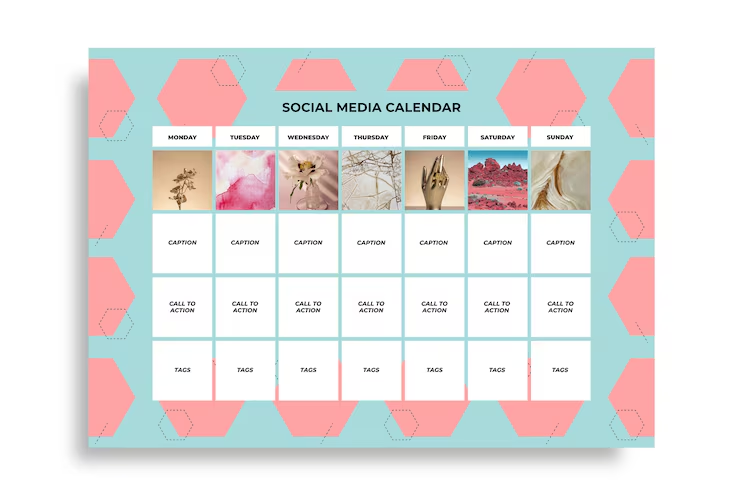
Content Calendar Template for Kenyan Businesses: Free 2026 Framework
Why Most Kenyan Businesses Fail at Content Marketing
The single most common failure mode in Kenyan content marketing is not content quality — it is content consistency. A business that publishes 12 high-quality blog posts in three months and then nothing for the next nine months will not rank, will not build audience, and will not see the compounding returns that consistent content produces. The businesses dominating Kenyan search results in any category sustained publishing for 18+ months — not for three.
A working content calendar is the operational discipline that produces consistency. This guide is a complete framework for building one.
The Three-Layer Content Calendar Structure
Layer 1: Quarterly themes
Every quarter, define 2–3 strategic themes content will reinforce. These tie content production to business strategy — preventing the calendar from becoming a random collection of posts disconnected from commercial outcomes.
Examples for a Kenyan web design agency: Q1 theme — “How Kenyan businesses get real ROI from their websites” supporting a website-redesign positioning push. Q2 theme — “Local SEO mastery for Kenyan SMEs” supporting expansion into local SEO services. Q3 theme — “eCommerce growth in the Kenyan market” supporting a new eCommerce specialisation. Q4 theme — “Year-end audit and 2027 planning” supporting strategy retainer renewals.
Each theme drives 8–15 content pieces across the quarter — blog posts, social media, email features, video — all reinforcing the strategic focus rather than scattering attention.
Layer 2: Monthly editorial calendar
Each month, schedule specific content pieces with: title and primary keyword target (for SEO content), publication date, owner (who is producing), distribution plan (where it will be promoted), and supporting content derivatives (social posts, email feature). The monthly calendar is detailed enough to drive execution but flexible enough to accommodate reactive content opportunities.
Layer 3: Weekly execution schedule
The day-to-day operating layer. Specific posts scheduled by day and platform. Production deadlines for upcoming pieces. Approval and review checkpoints. This layer is typically managed in a project management tool (Asana, Trello, ClickUp, or Notion) for content teams; in a simple spreadsheet for solo operators.
Content Categories Every Kenyan Business Should Plan Around
Educational content (40–50% of total output)
How-to guides, explainers, definitive resources answering specific questions your target audience is asking. This category drives the most SEO traffic and builds the most credibility — the workhorse of Kenyan content marketing.
Industry analysis and commentary (15–25%)
Your perspective on developments in your sector, with specific Kenyan context. New regulations, market shifts, technology changes, competitive moves — analysed through your professional lens. This category builds thought leadership and earns shares from industry peers.
Case studies and client outcomes (15–20%)
Specific named clients (with permission), specific challenges addressed, specific outcomes with verifiable numbers. The most commercially valuable content category — typically converts at significantly higher rates than educational content because it answers the prospect’s “can you do this for someone like me?” question directly.
Behind-the-scenes and culture content (10–15%)
Your team, your work process, your business decisions and the reasoning behind them. Builds the human connection that converts engaged followers into engaged customers — particularly important in Kenyan markets where business relationships are personal.
News, trends, and reactive content (5–10%)
Timely commentary on developments relevant to your audience. Maintains content freshness and signals active business operations to algorithms and audience alike.
The Weekly Cadence for a Typical Kenyan SME
The publication schedule for a Kenyan SME with one part-time content lead supported by an agency:
Monday: Long-form blog post published (1,500–2,500 words on a target SEO keyword). Email newsletter to subscriber list featuring the post and additional commentary.
Tuesday: LinkedIn post derived from the blog post (key insight extracted and developed for LinkedIn audience).
Wednesday: Instagram carousel or TikTok/Reels video derived from the blog post (visual format for visual-first audiences).
Thursday: Original commentary or industry observation post on LinkedIn (not derived from blog post — fresh content extending personal brand).
Friday: Behind-the-scenes content across Instagram Stories and similar — team, process, work-in-progress.
Weekend: Lower-pressure consumer content if relevant to your audience (food, lifestyle, weekend-relevant topics for B2C); rest period for B2B-focused brands.
This produces approximately 5–7 content touchpoints per week from one substantive content investment — sustainable for most Kenyan SMEs without requiring a large content team.
Building Your First Quarterly Calendar
Week 1: Strategic planning
Define quarterly themes connected to business strategy. List 8–15 specific content pieces aligned with each theme. Identify keyword targets for SEO-driven content using Google Keyword Planner or similar.
Week 2: Production planning
Allocate content pieces to weeks. Identify production owners. Confirm production timeline and approval workflow. Schedule content briefs.
Week 3 onwards: Execution
Produce content per the schedule. Publish on planned dates. Distribute through email and social channels. Track performance. Adjust execution based on what is working.
End of quarter: Review and adjust
Which content performed best? Which underperformed? What themes resonated with audience? What did not? Use these answers to refine the next quarter’s plan rather than starting from scratch.
Common Content Calendar Failures to Avoid
Over-planning, under-executing. Spending three weeks building an elaborate calendar then publishing nothing is worse than publishing imperfect content on a simple plan.
Calendar without strategy. A calendar that schedules content without quarterly themes connected to business strategy produces randomness, not coherent brand building.
Ignoring performance data. A calendar that does not adjust based on what is working accumulates patterns that do not produce results. Review monthly; adjust quarterly.
Burning out the team. A schedule that requires 60-hour weeks to maintain is unsustainable. Better to publish 3 high-quality pieces per week consistently for 18 months than 7 pieces per week for 3 months followed by collapse.
Content Marketing Services | Blog Writing Services | Content Strategy & SEO Copywriting | Social Media Content Services
Frequently Asked Questions
How often should a Kenyan business publish content?
For SEO-driven content (blog posts): minimum 2 substantial pieces per month, ideally 4–6 per month for businesses competing in moderately competitive Kenyan keywords. For social media content: 3–7 posts per week per active platform depending on platform algorithms. For email: 1–2 broadcasts per week to your subscriber list, plus automated sequences. Consistency matters more than absolute volume — 2 high-quality posts per week sustained for 18 months outperforms 7 posts per week for 3 months followed by silence.
Should Kenyan businesses post in English or Swahili?
For most professional services, B2B, and formal commercial contexts: English is the default. For consumer brands targeting younger Kenyan audiences, mixing English and Swahili (or Sheng for younger demographics) consistently outperforms pure English content. Test what works for your specific audience. Avoid pure Swahili content for B2B unless your audience specifically prefers it — it can read as less professional in formal commercial contexts despite being more inclusive linguistically.
What Kenyan holidays and events should drive content calendar?
Major content opportunities: Madaraka Day (June 1), Mashujaa Day (October 20), Jamhuri Day (December 12), Eid al-Fitr (variable), Christmas/New Year, Back-to-school period (January, May, September), Tax filing deadlines (June 30 individual returns), and Black Friday/Cyber Monday (which has been adopted by Kenyan eCommerce). Build relevant content 2–3 weeks before each event for SEO and social distribution. Avoid generic “Happy [Holiday]” posts with no commercial relevance — they perform poorly.
How far in advance should I plan content for my Kenyan business?
Quarterly planning works well for most Kenyan SMEs: themes and major content pieces planned 3 months in advance; specific weekly content scheduled 2–4 weeks in advance; reactive content (industry news, trending topics, current events) produced same-week. Planning much further than a quarter typically produces work that becomes irrelevant by publication; planning much less typically produces inconsistent execution.
Should Kenyan businesses repurpose content across platforms?
Yes — strategically. A single 2,000-word blog post can become: 5–8 LinkedIn posts (each pulling out a single insight), 3–4 Twitter/X threads, 2–3 Instagram carousel posts, 1 YouTube/TikTok video summarising the key points, 1 email newsletter feature, and source material for podcast or webinar content. Repurposing multiplies the ROI of high-quality content investment. Avoid simply cross-posting identical content — adapt format and angle for each platform’s native consumption patterns.
What Content Marketing Actually Produces for Kenyan Businesses
Content marketing is consistently misunderstood by Kenyan businesses as “posting on social media” or “writing blog posts occasionally.” Done correctly, it is the process of building a library of owned assets — articles, videos, guides — that generate compounding organic traffic, build topical authority, and convert readers into leads over years, not weeks.
The compounding return on content investment
A well-written article targeting a Kenyan search query, published once, can generate organic traffic for 3–7 years without any additional investment. An article ranking for a query generating 200 monthly clicks with a 3% email subscribe rate adds 6 new subscribers per month — every month — from a one-time content investment. A library of 100 such articles generates 600 new subscribers per month permanently. This compounding dynamic is why content marketing has the best long-term ROI of any Kenyan digital marketing channel.
What content consistently performs in Kenya
The highest-performing content formats for Kenyan business audiences: comparison articles (“Agency vs freelancer for web design in Kenya”), cost guides (“How much does SEO cost in Kenya 2026”), step-by-step how-to guides, case studies with specific verifiable outcomes, and local market analysis that addresses Kenya-specific realities. Generic content repurposed from international sources consistently underperforms locally-grounded content in Kenyan search results.
Distribution: why most Kenyan content fails
Publishing content without distribution is like printing a brochure and leaving it in a drawer. Every content piece needs a distribution plan: email broadcast to the subscriber list, social media promotion across relevant platforms, internal links from existing high-authority pages, and outreach to any relevant Kenyan publications or aggregators where a link might be earned. Without distribution, even excellent content sits unread.
Content Marketing Services | Blog Writing Services | Content Strategy
Got a Project in Mind? Let’s Talk.
You’ve got a vision — we’ve got the team to bring it to life. Let’s discuss your goals and turn them into powerful results.
Phone: +254 710 520 510
Email: hello@neliumsystems.com