


Content Marketing Services in Kenya






Got a Project in Mind? Let’s Talk.
You’ve got a vision — we’ve got the team to bring it to life. Let’s discuss your goals and turn them into powerful results.
Phone: +254 710 520 510
Email: hello@neliumsystems.com

How content marketing actually works in Kenya in 2026
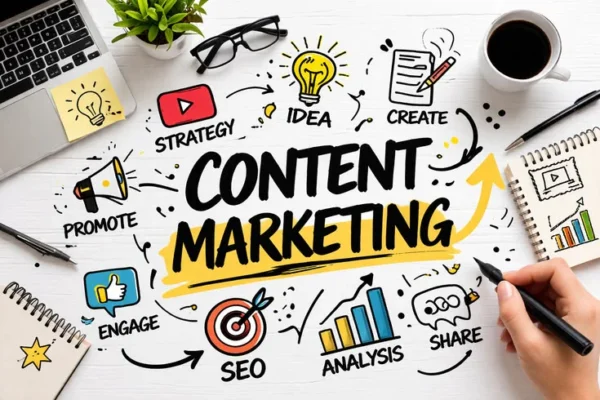
Most Kenyan businesses do "content" the way they do gym memberships: sign up, write three blog posts, lose interest, complain that "blogging doesn't work in Kenya." Content marketing isn't about publishing posts. It's about systematically owning the conversations your customers are already having on Google, YouTube, TikTok, and LinkedIn.
Done well, content marketing is the highest-leverage marketing investment most Kenyan SMEs can make — because it compounds, gets cheaper per result over time, and produces inbound leads that paid ads simply cannot match in quality. Below is how we approach content marketing for Kenyan businesses serious about owning their category.
Strategy starts with the buying journey, not topic ideas
"What should we blog about?" is the wrong starting question. The right one is: "What questions does our ideal customer ask the day they decide to buy something like ours, and 30 days before that, and 6 months before that?" We map content to the buying journey — awareness, consideration, decision — and weight production toward whichever stage produces the most leverage for the business.
Pillar pages do the heavy ranking lifting
A 4,000-word pillar page covering a topic comprehensively (e.g. "Digital Marketing in Kenya: Complete Guide") will outrank 20 thin 500-word posts on the same topic. We build 3–5 pillar pages per content cluster, surrounded by supporting articles, all interlinked. This is the structural pattern that beats Wikipedia for long-tail queries — and the same pattern we use for clients dominating their categories.
Local relevance is a competitive moat
"Best CRM software 2026" is impossible to outrank — HubSpot, Salesforce, and a dozen US blogs already won that battle. "Best CRM software for Kenyan SMEs" is winnable in 6 months. Adding local context (M-Pesa integration, Safaricom-friendly bandwidth, KRA tax compliance, Swahili language support) creates winnable angles even on competitive global topics. We build content around the angles where Kenyan businesses can credibly outrank international publishers.
Distribution is half the job
The "build it and they will come" theory of content marketing is dead. We treat each long-form piece as a hub that gets distributed across LinkedIn (carousels and posts), Twitter/X (thread breakdowns), email newsletter (excerpt + link), Reddit (relevant subreddit comment with link), industry publications (occasional guest-post adaptation), and internal sales enablement (PDFs for the sales team). One article, ten distribution surfaces.
Updating beats publishing for SEO compounding
An article published 18 months ago and refreshed today will outrank a brand-new article on the same topic 80% of the time. We allocate 25–30% of monthly content production budget to updates and expansions of existing pieces — adding new sections, refreshing statistics, adding internal links from new pieces, and improving meta data. This is the lever most Kenyan content programs ignore.
How we structure content marketing engagements
Strategy and audit (weeks 1–3)
Content audit of existing pieces, keyword research, competitor gap analysis, content cluster planning, editorial calendar for 90 days, distribution channel selection. End of week 3, you have a written content strategy document that explains exactly what to write, when, why, and how it connects to revenue.
Content production (monthly cadence)
2–4 long-form pieces per month at 1,500–3,000 words each, edited by a senior strategist, optimised for SEO and conversion, custom imagery or original screenshots where helpful. Plus 1–2 update cycles on existing pieces.
Distribution and amplification
Each piece gets at least 4 derivative formats produced in parallel — LinkedIn post, email send, social carousel, internal sales asset. Distribution starts the day the piece publishes and continues for 30+ days.
Get started with content that ranks and converts
- Request a free content audit — we review existing content and send a written gap analysis with priorities.
- WhatsApp or call: +254 758 870 937 or +254 710 520 510.
- Email: business@neliumsystems.com.
Frequently asked questions
How is content marketing different from blogging?
Blogging is content production. Content marketing is content production tied to a business outcome — ranking for high-intent keywords, generating leads, supporting paid-ads landing pages, building topical authority. Most "blogs" are content production with no strategic intent, which is why most blogs don't produce business value.
How much content do I need to publish to see results?
Less than the agencies selling you 8 posts a month want you to believe. We typically publish 2–4 deep pieces (1,500–3,000 words) per month for SEO clients, focused on highest-intent keywords. Then we update those pieces every 6–12 months — refreshing them often outperforms publishing new ones in the same topic cluster.
Do you write the content yourselves or use AI?
Senior strategists outline and edit. AI assists with first drafts and research synthesis. Final published content always has substantial human writing and Kenyan-market expertise built in. Pure AI-generated content ranks poorly, reads obviously synthetic, and doesn't build trust with sophisticated readers — we don't produce it.
Will the content rank on Google?
If we control the keyword research, content brief, and on-page optimization, yes — most pieces rank in the top 10 within 3–6 months for the targeted keyword. If you give us a topic with no underlying search demand or competitive feasibility, no. We turn down topic requests where the math doesn't work and propose alternatives instead.
Can the content be distributed beyond just sitting on the blog?
Yes — that's where most agencies fail. Every long-form piece we produce gets repurposed into social posts, email newsletter content, LinkedIn carousels, video scripts, and sometimes podcast outlines. The same article powers 6–10 channels, multiplying its working surface area without 6x-ing production cost.